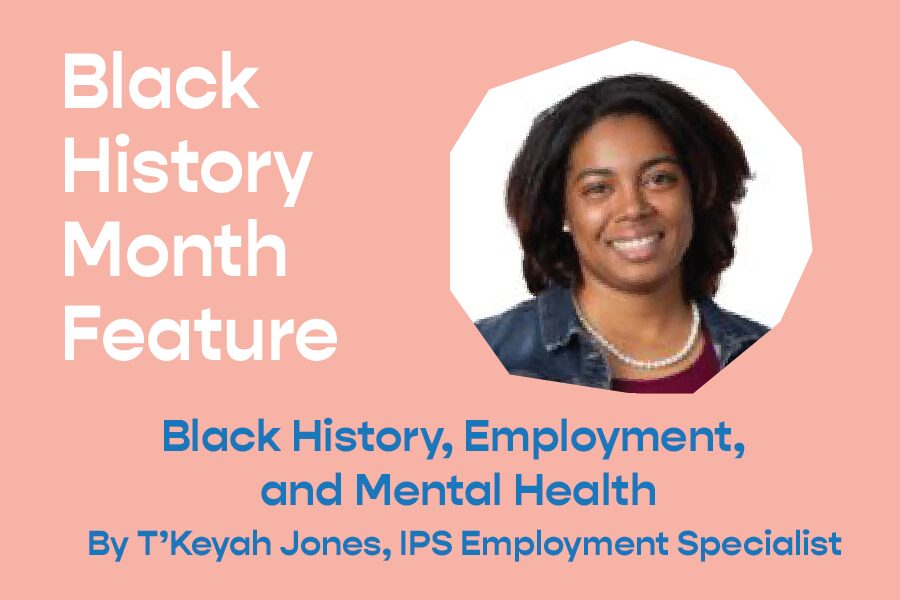
By T’Keyah Jones, IPS Employment Specialist

Black History Month Feature
In honor of Black History Month, Josselyn spotlights IPS Employment Specialist T’Keyah Jones as she shares her perspective on Black history, employment, and mental health.
As we celebrate Black History Month this year, I am grateful to the Black trailblazers who have created spaces for us to discuss mental health, emphasizing that we don’t need to be embarrassed for seeking help. We face a challenging battle, especially with generational mindsets, but I believe that things will improve.
Mental health remains a taboo subject in the Black community, as discussing it can be perceived as a sign that we don’t have it all together, which contradicts what we may believe. For many, the initial avoidance and rejection of mental health conversations stem from emotional reactions. Our culture has witnessed the struggles of Black individuals throughout history, and we’ve learned to adapt and persevere through various hardships, including racism, discrimination, and generational pain and anger. However, can we truly say we’re coping in a healthy way?
Additionally, the stress of seeking, obtaining, and maintaining employment complicates these challenges. We need jobs to pay bills (including student loans), purchase necessities, and save for the future. As a result, many individuals apply and interview for jobs often feeling anxious, while some disqualify themselves because they believe they may not fit the status quo for a particular position or think they are not the ideal candidate.
In my work with the Josselyn Individual Placement and Support (IPS) program, I have encountered clients referred internally and through the Division of Rehabilitation Services (DRS) who vocalize these thoughts. Some express skepticism about whether the program can truly help them, as they feel they have already exhausted all options. The IPS program collaborates with clients to provide support from the very start of the process all the way to the finish line. Key components of the program include:
- Sourcing potential job leads, job fairs, and volunteer opportunities
- Crafting and revising resumes
- Writing cover letters
- Interview preparations, including conducting mock interviews
- Conducting check-ins to monitor the client’s progress once they solidify employment
One benefit I have witnessed while working in this program is the trust that Black clients have in collaborating with diverse clinicians. Many have shared sentiments such as, “There were days when I didn’t want to meet, but meeting with my Employment Specialist gave me encouragement and motivation to keep trying,” and “Working with someone who truly listened to me and helped me find my job — I’m grateful for this program.” I am glad to continue advocating for and informing the Black community about housing, educational, social, vocational, and financial support that not only impacts mental health but also nurtures a person’s holistic well-being.